Media 1:

Where did you view or hear the media?
- I came across this first media while scrolling through my Facebook feed.
What is the genre and source of the media? (e.g. meme created by @gofindfun; advertisement in my feed)
- The genre is an image either made or found and shared by Erin Vecchio on Facebook.
How did you encounter this media? (e.g. shared by @markywells; checking my news feed)
- This image was shared by Whytnee on Facebook. No caption or comment was attached regarding her reaction to this media.
What was the purpose of the media?
- The purpose of the media was to raise awareness of the extortion of the healthcare system. There was what appeared to be a lot of facts on the image about the development of the discovery of insulin. The fact that certain words were highlighted meant that the creator had an agenda: cause people to become angry at healthcare, which I might add appeared to have worked based on the comments people left.
What was your initial reaction to the media? (laughed; clicked the link)
- My initial reaction to the media was speculation. I wanted to know the “facts” presented were indeed facts, so I clicked on the image to see if there was any source attached to the information. There was not any credible source listed.
Was your engagement with the media passive (scrolled past/didn’t view) or active (clicked the link/read or listened)? What motivated this type of engagement?
- My engagement with the media was active. I first clicked on the shared image to see if there was an article or source attached to the image. However all that was included was a hashtag: #MedicareForAll. There was no reference to any credible source, so I did my own digging. Turns out, the very first part in the image is misleading. The attached sources (Science History Institute, Medical News Today, and Michael Bliss Article) reveal that there was a controversy in the receiving of the Nobel Prize for the discovery of insulin. This alone discredited the media due to the creator’s ignorance of this simple, well-documented controversy. There is still some truth to the post: they did sell the patent for $1, but some of the other details may not be exact. For example, two sources I looked at estimated that patient would pay up to about $400 a month for insulin. Also, the creators did not sell the patent for $1 so it could be free. They did so in order for the insulin to be affordable to those who needed it. This post definitely had a different agenda in mind, and when I went back to take a second look at it, it had been removed by the creator.
If your engagement was active, provide the rhetorical situation for the media (1 per week)
- Purpose: The purpose of this media at first glance appears to be advocating for the spike in prices of insulin, but after some digging the avocation seem to rather be the hashtag/movement #MedicareForAll
- Audience: The intended audience seems to be people that either suffer from or have relatives/friends that suffer from diabetes.
- Genre: The medium used was Facebook, and the genre used was an image.
- Context: This is being discussed by Facebook users who share this to raise “awareness” to the extortion of the healthcare system, as this is an issue that concerns anyone suffering from diabetes.
- Exigence: This media seems to be focusing on the negative. It wants to invoke anger in those who see it in order to get them to act and continue to express their discontent with healthcare, and in a sense, spread the #MedicareForAll idea.
- Subject: The subject of this media is healthcare and it’s unfairness to people, diabetics specifically for this example.
Media 2:

Where did you view or hear the media?
- I came across this second media while scrolling through my Facebook feed.
What is the genre and source of the media? (e.g. meme created by @gofindfun; advertisement in my feed)
- The genre is a meme either made or found and shared by House of Dank.
How did you encounter this media? (e.g. shared by @markywells; checking my news feed)
- This image was shared on Facebook by Brenda. No caption or comment was attached regarding her reaction to this media, but I assumed she shared it for comedic relief.
What was the purpose of the media?
- The purpose of the media is comedy. It does not raise anything of importance that must be addressed to the public.
What was your initial reaction to the media? (laughed; clicked the link)
- I laughed at this meme. The meme served its purpose. That was the only thing the meme seemed to be focusing on.
Was your engagement with the media passive (scrolled past/didn’t view) or active (clicked the link/read or listened)? What motivated this type of engagement?
- My engagement with the media was somewhat active. I first clicked on the image to see it better. The meme made me stop and scroll through the comments to see what others were saying about it since this seems like something a lot of people can relate to.
Media 3:
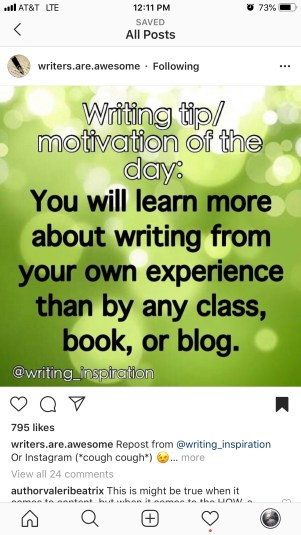
Where did you view or hear the media?
- I came across this third media while scrolling through my Instagram feed.
What is the genre and source of the media? (e.g. meme created by @gofindfun; advertisement in my feed)
- The genre is supposed to be a writing inspirational image made by @writing_inspiration on Instagram.
How did you encounter this media? (e.g. shared by @markywells; checking my news feed)
- This media was reposted by @writers.are.awesome, a writing page I follow. The fact that the page that I follow reposted this made me question not only the creator of this image but also the writing page I follow.
What was the purpose of the media?
- The purpose of the media is to inspire people who want to be writers. Now, it seems like the image suggests that one does not have to take any formal writing course or read blogs or books to learn about writing or to become a better writer.
What was your initial reaction to the media? (laughed; clicked the link)
- Doubt. I questioned it right away. I scrolled through the comments, wanting to leave one myself but decided against it because I did not want to get into a debate with anyone who was inspired by this. I just completely disagreed with it and went to the page where this media was created to see what kind of credibility I could apply to such a post. I looked for any mention of a famous author who stated this or some form of reference, but there was not any. It would be a completely different story if this phrase was attached to an interview of a famous author like Stephen King. But given that there was no credible source, I did not take this post seriously.
Was your engagement with the media passive (scrolled past/didn’t view) or active (clicked the link/read or listened)? What motivated this type of engagement?
- My engagement with the media was active. I completely disagreed with the post, so my disagreement forced me to spend time with this post. To me, it seemed like one of those “you don’t have to go to college to be a success” posts. Now, there may be truth in such posts. But I questioned this one. It may have served it’s purpose in inspiring people who do not have access to those resources (classes, books or blogs). Yet, this media was shared on a social media platform. If it was shared for people who do not have access to classes, books, or blogs, shouldn’t those people also potentially not have access to the internet and therefore social media?
Media 4:
Where did you view or hear the media?
- I came across this ad while scrolling through my Facebook feed, so I flagged it because I knew this was something I wanted to spend more time with.
What is the genre and source of the media? (e.g. meme created by @gofindfun; advertisement in my feed)
- The original genre that I saw this in was an advertisement video for Masterclass on Facebook. The source of the advertisement is, of course, Masterclass.
How did you encounter this media? (e.g. shared by @markywells; checking my news feed)
- I came across this random Masterclass advertisement while scrolling through my Facebook feed. I do not remember clearly but I think I had been conducting a Google search for PhD’s in creative writing before I hopped on Facebook and came across this, so perhaps it was not so “random” after all.
What was the purpose of the media?
- The purpose of this media was to advertise Masterclass’s new class taught by Neil Gaiman and in general to advertise their courses on Facebook. The one with Neil Gaiman was one of the most recent courses, so they used that video to draw people into checking out what else they had to offer.
What was your initial reaction to the media? (laughed; clicked the link)
- When I came across this media, I stopped scrolling and clicked on the link to watch the full video. Since I will be searching for ways to improve my creative writing abilities post-graduate school, I was very interested in this video. I took it a step further and went to the website to check out what they had to offer.
Was your engagement with the media passive (scrolled past/didn’t view) or active (clicked the link/read or listened)? What motivated this type of engagement?
- My engagement with the media was active. I first clicked on the video and proceeded to go to the website. On the website, I took a closer look at the course that was being advertised as well as looked for other writing courses. I was interested in what was being offered and would have likely purchased the all access if I was not already taking two graduate writing courses. This will likely be something I go back to post-graduation.
Media 5:
Where did you view or hear the media?
- My fifth media is a video that I came across in my Facebook feed.
What is the genre and source of the media? (e.g. meme created by @gofindfun; advertisement in my feed)
- The genre for this media is a video. The original source of the video is from America’s Got Talent’s Facebook page and was one of the performances that received the golden buzzer.
How did you encounter this media? (e.g. shared by @markywells; checking my news feed)
- This media was shared by Haley on Facebook.
What was the purpose of the media?
- The purpose of the media was to entertain and showcase one of the golden buzzer performances on the show.
What was your initial reaction to the media? (laughed; clicked the link)
- When I saw that it had something to do with drawing/painting I clicked on it. I wanted to see what was being drawn or painted. Only, I soon realized it was not at all what I was expecting. The performer was depicting a unique story using music and sand drawing.
Was your engagement with the media passive (scrolled past/didn’t view) or active (clicked the link/read or listened)? What motivated this type of engagement?
- My engagement with the media was active. I first clicked on the video and watched the entire performance. I really wanted to see what the performer was going to do, so I was drawn in. After I clicked on it, her method of storytelling held my attention. Once I finished watching the video, I decided to share it because I was very impressed with the performance.

 H. J. Ortiz